Thursday, February 21, 2019

September 29: Walking tour of Siena, Tuscany, Italy

September 29, 2017: Walking tour of Siena

Siena in Tuscany is not too far from where we were staying. Siena is only about 25 miles from our hotel, the Borgo di Cortefreda.
We left early around 8:30 after our breakfast at the hotel. The sky was a little cloudy when we started out, but began to brighten and the greys turned to bright blues. The drive was quite comfortable and our tour director was busy filling us up with details.


After about half an hour of driving, we reached the outskirts of Siena.


We began our walking tour under the supervision of our excellent guide.


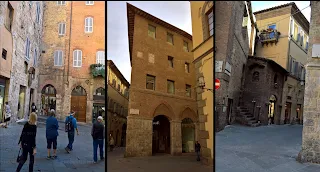
Siena still remains a medival city as it retains most of the original structures including the public buildings. We walked through many of the narrow streets such as this one here.


Siena is divided into 17 Contradas (means a ward or a district) each having its animal own symbol. The folks from these districts participate in the famous horse race of Siena, Palio of Siena. 


You can see the district boundaries all over the city and the districts compete each other in the Palio played out every year in the Piazza Del Campo.

The districts are very proud of their colors and zealously mark-up themselves.


Here is a statue of a little boy marking a contrada.


Lots of chocolate and biscuit (biscotti) shops along the route.


After walking many of these tortuous, narrow streets we came to the Piazza Salimbeni to look at the statue of Sallustio Bandini. Salustio Bandini was a descendent of Piccolomini (who later became a Pope), advocate of free trade; archdeacon, economist and politician.  Bandini donated his 3000 volumes to Bibliotheca della Spaienza. Located here is one of the oldest banks of Italy.


We also came across the famous 'wolf suckling infants', a recurrring theme in Italy. 

According to the legend, Siena was founded by Remus’ sons, Senius and Aschius, who left Rome with the statue of the she-wolf, stolen from Apollo’s temple. The symbolic colors of the city derive as well from these two legendary founders--Aschius rode a black horse and Senius rode a white one.


It was indeed an interesting to walk .


Our guide toook us to the Piazza Del Campo, the venue of the famous horse race ( the Palio, https://en.wikipedia.org/wiki/Palio_di_Siena) in which the 17 districts participate. The ground is not perfectly circular; the Palazzo Pubblico which houses a museum (we did not enter) adjacent to the Torre del Mangia (bell tower), is typical of Siense medieval architectural style.


Il Palio Siena in progress from


We cross the Piazza del Campo.. 


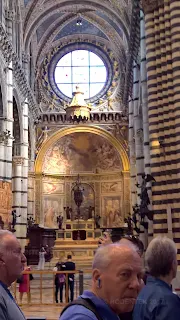
... and move towards another most famous structure, the Cathedral of Siena (aka DOM di Siena). We arrive at the Cathedral of Siena.


Photo: Alan Kehew from his Pinterest site


Photo: Alan Kehew from his Pinterest site

Photo: Alan Kehew from his Pinterest site


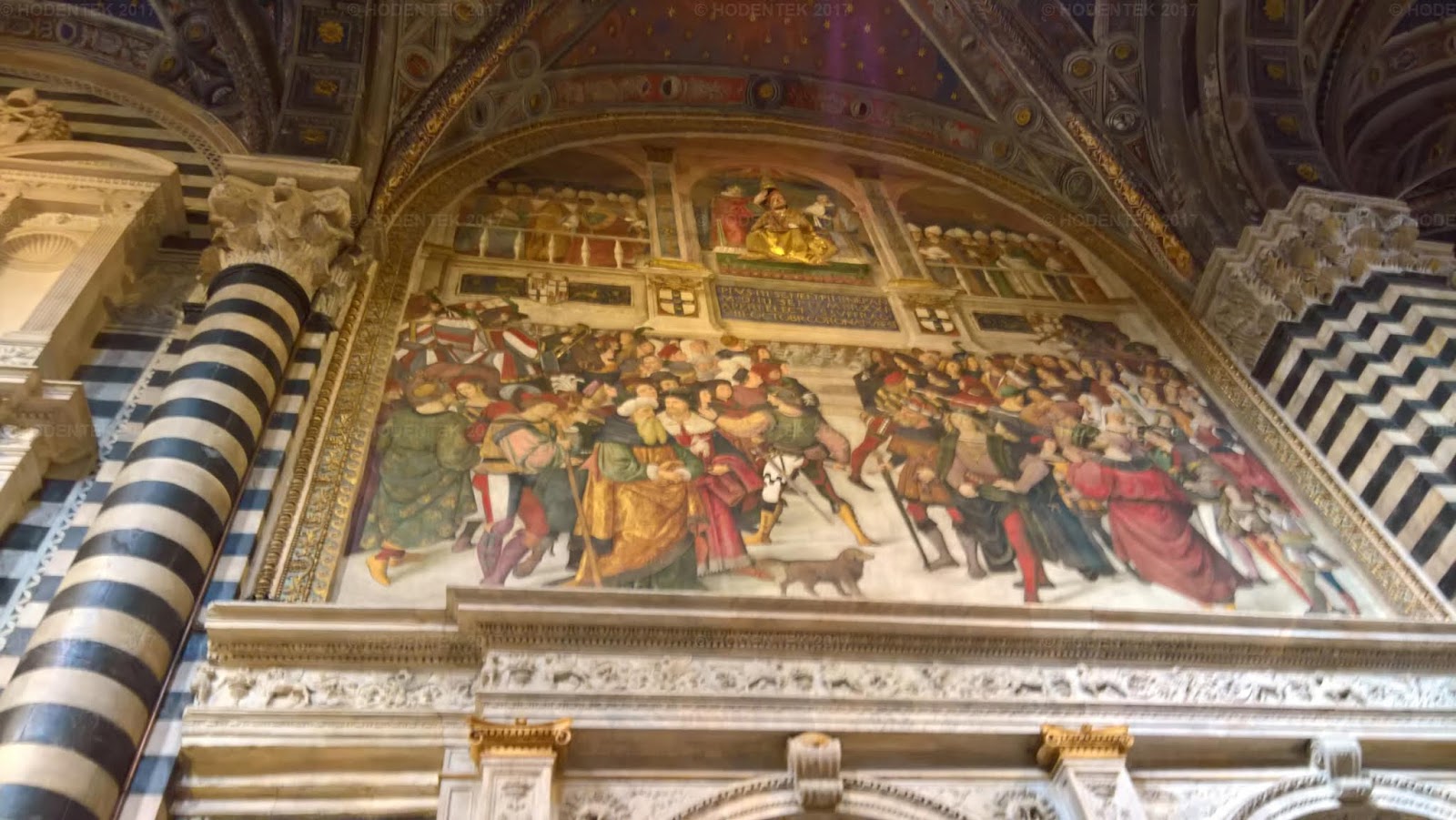
The Three Graces inside Piccolomini Library inside the Siena Cathedral


We completed our visit to the DOM by about 1:30 and we started looking for a place to eat lunch. We had about an hour to have lunch. After lunch we retraced the path to the bus that would take us to our hotel.


One has to be careful in restaurants. Often you will be paying for something you did not ask. Happened a couple of times and in Siena as well. The more crowded the restaurant is, more careful you should be.


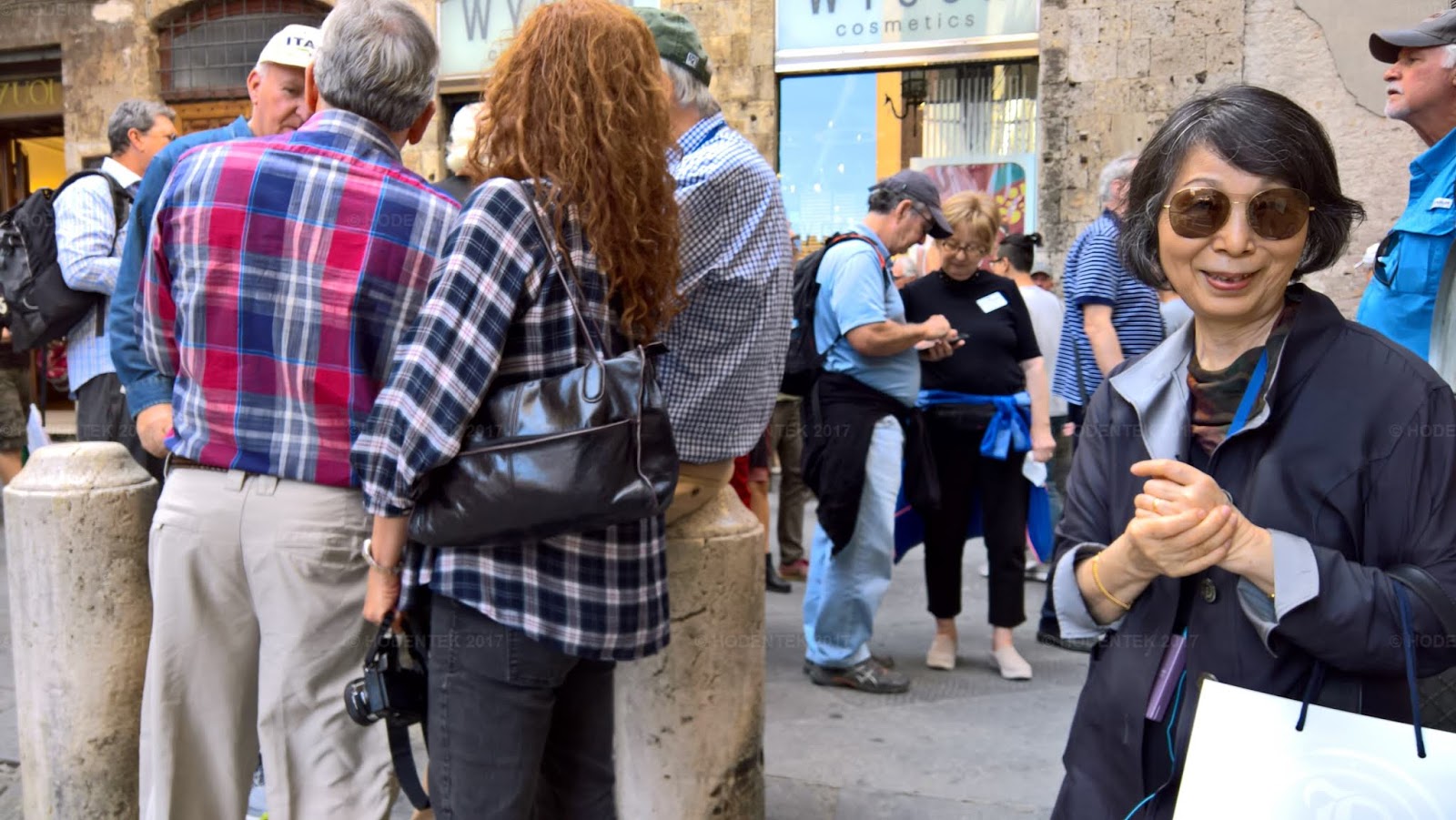
We are waiting for few more people to return. 


Here is a short video clip.


Here is the complete video of the Powr Point:


Yet another place to visit in your Italyt rip


Wednesday, January 23, 2019

What is a TPC benchmark?

TPC is an acronym for Transaction Processing Corporation, a non-profit organization to define transaction processing benchmarks and providing objective, verifiable performance data to the industry.

Here is the scope of TPC from its website (http://www.tpc.org/information/about/abouttpc.asp):

"The term transaction is often applied to a wide variety of business and computer functions. Looked at as a computer function, a transaction could refer to a set of operations including disk read/writes, operating system calls, or some form of data transfer from one subsystem to another.
While TPC benchmarks certainly involve the measurement and evaluation of computer functions and operations, the TPC regards a transaction as it is commonly understood in the business world: a commercial exchange of goods, services, or money. A typical transaction, as defined by the TPC, would include the updating to a database system for such things as inventory control (goods), airline reservations (services), or banking (money).
In these environments, a number of customers or service representatives input and manage their transactions via a terminal or desktop computer connected to a database. Typically, the TPC produces benchmarks that measure transaction processing (TP) and database (DB) performance in terms of how many transactions a given system and database can perform per unit of time, e.g., transactions per second or transactions per minute"

Here is what SQL Server 2017 performance looks like.


Sunday, January 13, 2019

My source of happiness

Why am I happy today?

I hail from Mysore (mysorian@gmail.com), the most beautiful city in India.

They have named a road in London, England as 'Mysore Road'.


If you are from Mysore, India, I am sure you are also proud of this city of Palaces, Public Gardens and majestic Squares.

Monday, December 31, 2018

Wishing you all a Happy New Year 2019.

Wishing you all a Happy New Year 2019.


Thank you for reading my blog. See you in 2019

Thursday, December 06, 2018

Bringing JSON data into PowerBI

JSON data source were recently added to Power BI Data sources.

{
I have taken this JSON file from the following site;


and I will be using in this post.

Here is an abbreviated JSON file (with *.json extension) I am using.
--------------------------------------

  "data": [
    {
      "name": "Garrett Winters",
      "designation": "Accountant",
      "salary": "$170,750",
      "joining_date": "2011/07/25",
      "office": "Tokyo",
      "extension": "8422"
    },
    {
      "name": "Brielle Williamson",
      "designation": "Integration Specialist",
      "salary": "$372,000",
      "joining_date": "2012/12/02",
      "office": "New York",
      "extension": "4804"
    },
     ,
     ,
    {
      "name": "Quinn Flynn",
      "designation": "Support Lead",
      "salary": "$342,000",
      "joining_date": "2013/03/03",
      "office": "Edinburgh",
      "extension": "9497"
    }
  ]
}
-----------
Note that each Json element has six attributes.

Step 1:
You first need to save it to a location of your choice. You could also have it on an URL, but here it is assumed to be in one of the folders.

Launch PowerBI; Click GetData; Click More...

Click JSON


You need to browse and locate your JSON file (it will have  a.json extension).


My Koding.json file is now in Data View as shown.


 I go back to Edit Queries as I did not edit earlier.


 Now I have a query as shown in the left pane.


I had 15 elements in the JSOn file and they have become 16 records after getting it into PowerBI. Now go back to query using Edit Query as before. Now you see an extra control in Column 1 for splitting into its components.


I click the split control. The Query now appears as shown.


Now I convert this into table as shown above. Now what I see in DataView is the following:


The six elements are resolved into six fields as shown above. We will use this later. Click File | Save to save this file in the .pbix format. Presently it has the JSON data only.


That is all folks!

DMCA.com Protection Status